Imperial German Prussia Iron Cross 2nd Class EK II Ribbon Bar 1914 Pinback
- Regular price
- $55.00
- Sale price
- $55.00
- Regular price
SKU: 02-11
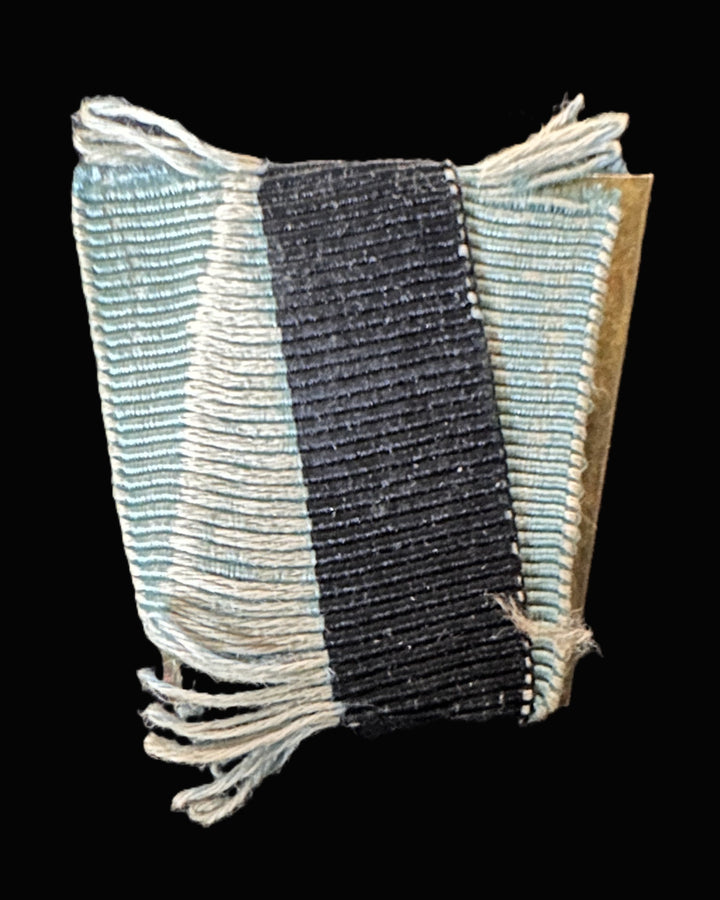
Original Imperial German Eisernes Kreuz 2. Klasse (Iron Cross 2nd Class), 1914 issue — single-place tunic ribbon bar with pinback assembly, in the form worn by veterans, officers, and non-commissioned ranks on field and service uniforms in place of the full decoration. The piece consists of an original period combatant ribbon mounted across a gilt-finished metal backing plate with the standard pin-and-catch attachment for tunic wear.
The ribbon is the standard Eisernes Kreuz 1914 combatant pattern: a black ribbed silk field approximately 25 millimeters (one inch) wide, flanked by two narrow white stripes near each edge — the so-called Kämpfer-Bandfarbe or front-line ribbon, which distinguished active-service recipients from non-combatants who received the same decoration on a reversed white ribbon with black edge stripes. The ribbon is mounted in the textbook Imperial German tunic-bar configuration, folded across the backing plate with the front face presenting in the correct orientation and the surplus material drawn around to the reverse. The ribbed silk weave shows good original color retention with the gentle age-toning, edge fraying, and minor surface wear consistent with a piece that saw period service rather than long display storage.
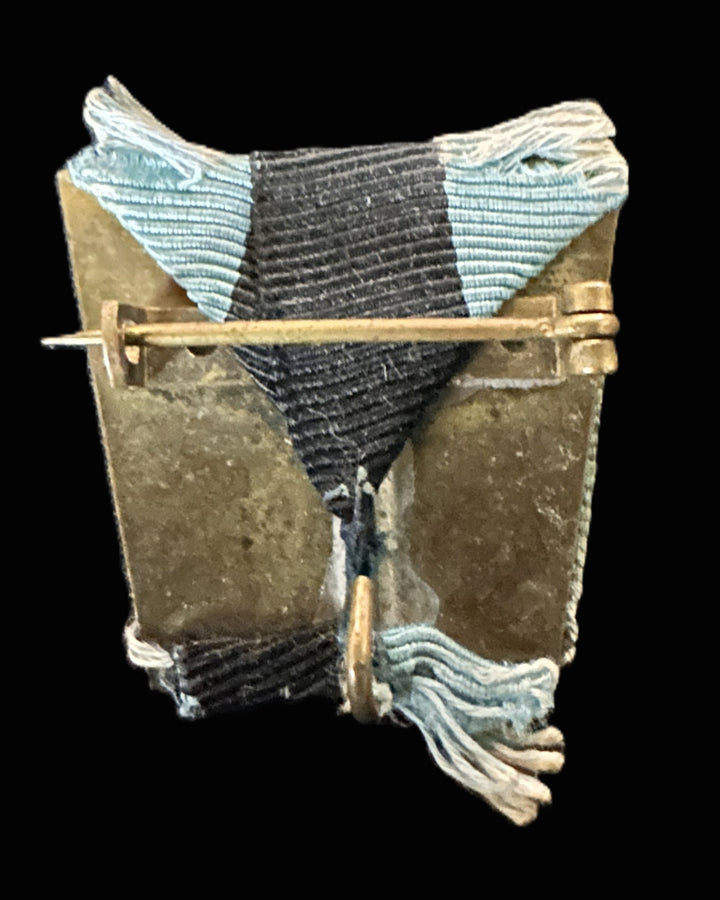
The reverse carries the gilt-finished metal backing plate with the period-correct horizontal pin, hinge, and catch hook — all functional, with the catch closure operating cleanly. A small additional suspension ring is present on the assembly, of the type sometimes used in period to mount a miniature device or supplementary attachment, presented here as-found without speculation as to original configuration. The overall construction is typical of Imperial German tunic ribbon bars produced before and during the 1914–18 period.
In the German nomenclature: Eisernes Kreuz (Iron Cross), 2. Klasse (2nd Class), Bandschnalle (ribbon bar/buckle), Kämpfer-Bandfarbe (combatant ribbon coloration), Feldgrau (field gray, the Imperial uniform color this bar would have been worn against).
Historically, the Iron Cross was instituted on 10 March 1813 by King Friedrich Wilhelm III of Prussia during the Wars of Liberation against Napoleonic France, designed by the architect Karl Friedrich Schinkel and conceived as an egalitarian decoration awardable across the full range of ranks for service in the field. The decoration was reauthorized for the Franco-Prussian campaign of 1870 by King Wilhelm I and again on 5 August 1914 by Kaiser Wilhelm II at the outset of the conflict that would conclude the Imperial era. Across all three issues — 1813, 1870, and 1914 — the basic design remained the same: a black-finished cast-iron core within a silver frame, with the date of the relevant authorization appearing on the lower obverse arm.
The 1914 issue is by far the most commonly encountered in collector circles, reflecting the scale of the conflict and the breadth of recipients across the German armed forces. The Iron Cross 2nd Class was awarded in vastly greater numbers than the 1st Class, and the standard convention for wear placed the full 2nd Class decoration on the recipient's parade uniform while substituting the ribbon — either as a single ribbon worn through the second buttonhole of the tunic, or as a tunic-bar of the type pictured here — on field and service uniforms. The single-place ribbon bar with pinback was thus a standard tunic accessory for any Imperial German soldier or officer who held the Iron Cross 2nd Class, and surviving original examples document the practical wear convention of the period.
The Imperial 1914 Iron Cross and its associated ribbons and bars sit at the foundation of Prussian and German military collecting. The decoration is unambiguously Imperial-period — instituted under Friedrich Wilhelm III in 1813, reauthorized by Wilhelm I in 1870, and reauthorized by Wilhelm II in 1914 — and the dated lower obverse arm makes period attribution straightforward where the full decoration is present. For the ribbon bar specifically, original examples in correct combatant configuration with intact backing hardware represent the most desirable form, and complete pinback assemblies that have survived their original tunic mounting without loss of pin or catch are preferred over loose ribbon fragments.
Within the Collect by Imperial German State framework, the Iron Cross is a Prussian state decoration that was extended through the Imperial framework as a pan-German award available across all twenty-five constituent states. A 1914 Iron Cross 2nd Class ribbon bar with pinback is a foundational accessory item for any Prussian or Imperial German tunic display, for any 1914–18 grouping, or for completing the wear configuration of a full Iron Cross 2nd Class set.
Condition is honest throughout. The ribbed silk ribbon retains good original color with the light age-toning, edge fraying, and surface wear consistent with a piece that experienced period tunic wear; no staining, repair work, or modern alteration is present. The gilt-finished backing plate shows even age patina with no significant loss of finish. The pin, hinge, and catch are intact, original, and functional. The overall presentation is that of a textbook Imperial German tunic-bar in untouched, as-acquired condition.